
How does a hydroponic tower work to maximize nutrient absorption?
Imagine a vertical, ethereal pavilion where plants don't draw life from the soil, but rather their roots are directly bathed in nutrient-rich mist or streams, precisely acquiring every ounce of nutrients they need for growth. This is the hydroponic tower, an innovative technology that pushes agricultural efficiency to the extreme. So, how does a hydroponic tower work to achieve this near-perfect nutrient absorption? Its core lies in a highly controllable closed-loop system that precisely regulates multiple dimensions, including nutrients, water, oxygen, and light, enabling plants to absorb nutrients several times more efficiently than with traditional soil cultivation.
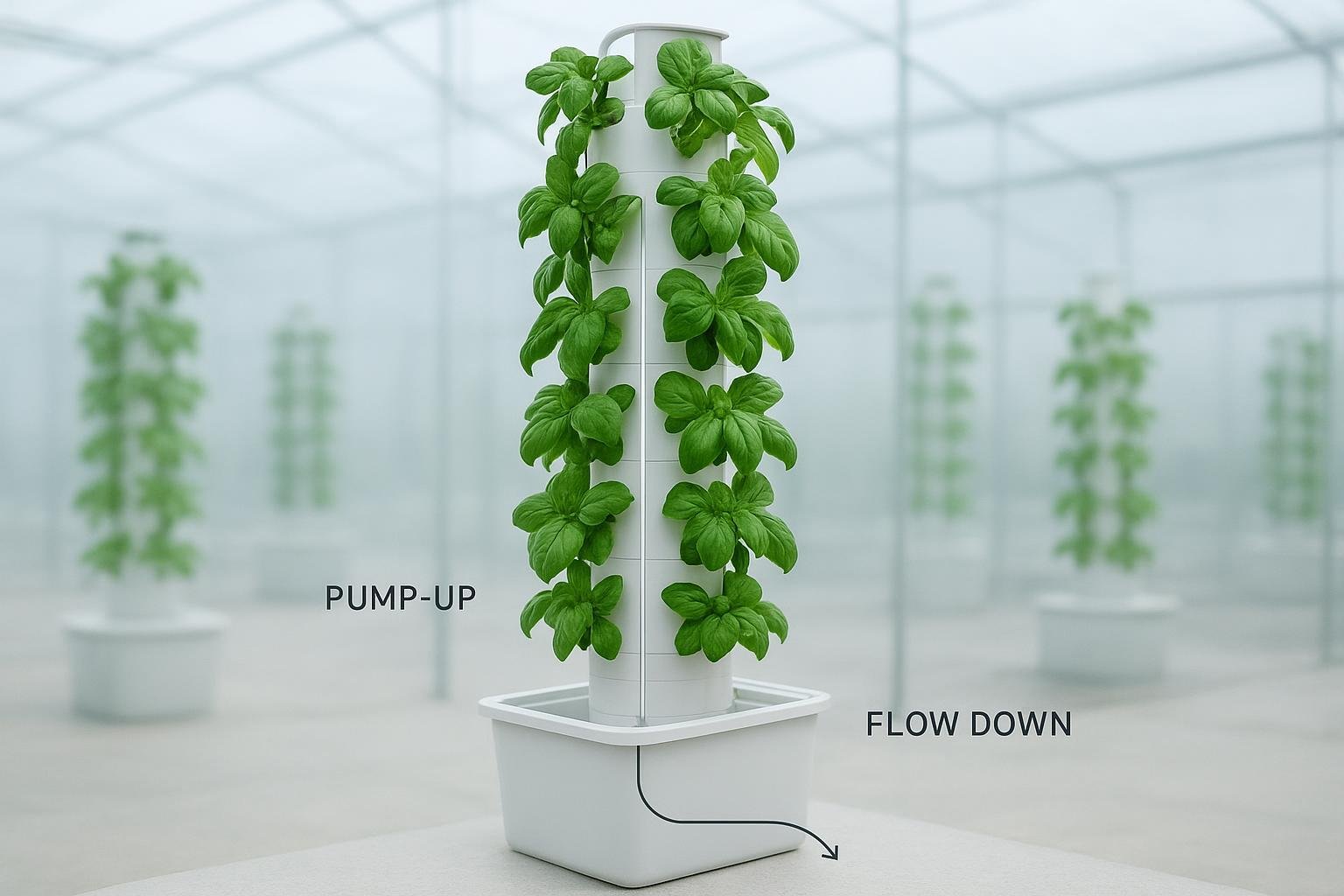
The hydroponic tower's structure is designed for efficient absorption. Typically, a home-use hydroponic tower is between 1.5 and 2.5 meters high, occupying only 0.5 square meters in diameter, yet it can accommodate 20 to 40 leafy vegetables through vertically stacked planting holes. The nutrient solution is pumped to the top of the tower and, under gravity, meanders down at a flow rate of approximately 100 to 200 milliliters per second, flowing through the exposed roots of each plant. According to a study in the journal *Horticultural Science*, this continuous, thin-layered liquid flow maintains the dissolved oxygen concentration in the nutrient solution around the roots at over 8 mg/L, far exceeding the 5 mg/L of static hydroponics. This high-oxygen environment increases root respiration rates by nearly 70%, significantly enhancing the cells' ability to actively transport ions such as potassium, nitrogen, and phosphorus. For example, at AeroFarms—the world's largest vertical farm—its patented aeroponic tower technology atomizes the nutrient solution into particles with a diameter of 50 micrometers, increasing effective root surface area contact by 300%, ultimately achieving an astonishing 50% shorter growing season compared to traditional agriculture, while increasing water use efficiency by 95%.
 Nutrition management strategies act as the "smart brain" for maximizing absorption. The system monitors absorption in real time using EC (electrical conductivity, mS/cm) and pH values. For example, the ideal EC range for leafy vegetables during their growing season is between 1.2 and 1.8 mS/cm, with a strictly controlled pH environment of 5.5 to 6.5. A standard automated control system checks nutrient solution parameters every 30 minutes and adjusts them by adding acid, alkali, or mother liquor, keeping deviations within ±5%. This precise control ensures that trace elements such as iron and manganese are within their optimal solubility range, preventing precipitation and ineffectiveness. Data shows that precision nutrient management can increase fertilizer utilization from less than 50% in soil cultivation to over 90%, while reducing fertilizer consumption by approximately 60%. As demonstrated by Plenty at its San Francisco farm, by analyzing the correlation between plant growth images and nutrient absorption data using machine learning algorithms, they can predict and adjust the formula in advance, increasing arugula yield by another 30%.
The synergistic optimization of environmental factors further unlocks absorption potential. In enclosed or semi-enclosed indoor vertical farms, LED grow lights provide 17 to 20 moles of photosynthetically active photon flux (PPFD) per square meter per day, with light cycles precisely simulating optimal light environments, such as providing lettuce with 16 hours of light per day. The temperature is kept constant at 22±2°C, and the relative humidity is maintained at 65% to 70%. Under these ideal conditions, plants do not need to cope with drought, pests, or extreme temperature stress, and can dedicate almost all of their metabolic energy to growth and nutrient absorption. A comparative experiment showed that, under the same nutrient supply, spinach grown in a controlled hydroponic tower had a 220% higher nitrate absorption rate than open-field cultivation, while its vitamin C content increased by 15%. In 2019, Singapore's Sky Greens farm, using its unique "A-Go-Gro" rotating hydroponic tower, achieved an annual production capacity of 80 tons of leafy green vegetables with only 1% of the land and 5% of the water resources of traditional agriculture—a model of environmental and technological integration.
From an economic and sustainability perspective, efficient absorption directly translates into quantifiable benefits. A commercial medium-sized hydroponic tower system with an initial investment of approximately US$3,000 can produce approximately US$8,000 worth of produce annually when growing high-value herbs or lettuce, shortening the payback period to 12 to 18 months. Due to the extremely low risk of pests and diseases, pesticide use is almost zero, meeting organic certification standards, and product premiums can reach 20% to 30%. More importantly, its annual yield per unit area is more than 10 times that of traditional farmland, while reducing water consumption by 90%, providing a disruptive solution for urban agriculture and food security in resource-scarce regions. In short, understanding how a hydroponic tower works means understanding a revolution in resource utilization efficiency—it transforms agriculture from a geographically dependent system of "extensive planting with low yields" to intelligent manufacturing of "precision feeding," ensuring that every drop of nutrition and every unit of energy reaches its target, creating unprecedented growth miracles.
Nutrition management strategies act as the "smart brain" for maximizing absorption. The system monitors absorption in real time using EC (electrical conductivity, mS/cm) and pH values. For example, the ideal EC range for leafy vegetables during their growing season is between 1.2 and 1.8 mS/cm, with a strictly controlled pH environment of 5.5 to 6.5. A standard automated control system checks nutrient solution parameters every 30 minutes and adjusts them by adding acid, alkali, or mother liquor, keeping deviations within ±5%. This precise control ensures that trace elements such as iron and manganese are within their optimal solubility range, preventing precipitation and ineffectiveness. Data shows that precision nutrient management can increase fertilizer utilization from less than 50% in soil cultivation to over 90%, while reducing fertilizer consumption by approximately 60%. As demonstrated by Plenty at its San Francisco farm, by analyzing the correlation between plant growth images and nutrient absorption data using machine learning algorithms, they can predict and adjust the formula in advance, increasing arugula yield by another 30%.
The synergistic optimization of environmental factors further unlocks absorption potential. In enclosed or semi-enclosed indoor vertical farms, LED grow lights provide 17 to 20 moles of photosynthetically active photon flux (PPFD) per square meter per day, with light cycles precisely simulating optimal light environments, such as providing lettuce with 16 hours of light per day. The temperature is kept constant at 22±2°C, and the relative humidity is maintained at 65% to 70%. Under these ideal conditions, plants do not need to cope with drought, pests, or extreme temperature stress, and can dedicate almost all of their metabolic energy to growth and nutrient absorption. A comparative experiment showed that, under the same nutrient supply, spinach grown in a controlled hydroponic tower had a 220% higher nitrate absorption rate than open-field cultivation, while its vitamin C content increased by 15%. In 2019, Singapore's Sky Greens farm, using its unique "A-Go-Gro" rotating hydroponic tower, achieved an annual production capacity of 80 tons of leafy green vegetables with only 1% of the land and 5% of the water resources of traditional agriculture—a model of environmental and technological integration.
From an economic and sustainability perspective, efficient absorption directly translates into quantifiable benefits. A commercial medium-sized hydroponic tower system with an initial investment of approximately US$3,000 can produce approximately US$8,000 worth of produce annually when growing high-value herbs or lettuce, shortening the payback period to 12 to 18 months. Due to the extremely low risk of pests and diseases, pesticide use is almost zero, meeting organic certification standards, and product premiums can reach 20% to 30%. More importantly, its annual yield per unit area is more than 10 times that of traditional farmland, while reducing water consumption by 90%, providing a disruptive solution for urban agriculture and food security in resource-scarce regions. In short, understanding how a hydroponic tower works means understanding a revolution in resource utilization efficiency—it transforms agriculture from a geographically dependent system of "extensive planting with low yields" to intelligent manufacturing of "precision feeding," ensuring that every drop of nutrition and every unit of energy reaches its target, creating unprecedented growth miracles.
Nutrition management strategies act as the "smart brain" for maximizing absorption. The system monitors absorption in real time using EC (electrical conductivity, mS/cm) and pH values. For example, the ideal EC range for leafy vegetables during their growing season is between 1.2 and 1.8 mS/cm, with a strictly controlled pH environment of 5.5 to 6.5. A standard automated control system checks nutrient solution parameters every 30 minutes and adjusts them by adding acid, alkali, or mother liquor, keeping deviations within ±5%. This precise control ensures that trace elements such as iron and manganese are within their optimal solubility range, preventing precipitation and ineffectiveness. Data shows that precision nutrient management can increase fertilizer utilization from less than 50% in soil cultivation to over 90%, while reducing fertilizer consumption by approximately 60%. As demonstrated by Plenty at its San Francisco farm, by analyzing the correlation between plant growth images and nutrient absorption data using machine learning algorithms, they can predict and adjust the formula in advance, increasing arugula yield by another 30%.
The synergistic optimization of environmental factors further unlocks absorption potential. In enclosed or semi-enclosed indoor vertical farms, LED grow lights provide 17 to 20 moles of photosynthetically active photon flux (PPFD) per square meter per day, with light cycles precisely simulating optimal light environments, such as providing lettuce with 16 hours of light per day. The temperature is kept constant at 22±2°C, and the relative humidity is maintained at 65% to 70%. Under these ideal conditions, plants do not need to cope with drought, pests, or extreme temperature stress, and can dedicate almost all of their metabolic energy to growth and nutrient absorption. A comparative experiment showed that, under the same nutrient supply, spinach grown in a controlled hydroponic tower had a 220% higher nitrate absorption rate than open-field cultivation, while its vitamin C content increased by 15%. In 2019, Singapore's Sky Greens farm, using its unique "A-Go-Gro" rotating hydroponic tower, achieved an annual production capacity of 80 tons of leafy green vegetables with only 1% of the land and 5% of the water resources of traditional agriculture—a model of environmental and technological integration.
From an economic and sustainability perspective, efficient absorption directly translates into quantifiable benefits. A commercial medium-sized hydroponic tower system with an initial investment of approximately US$3,000 can produce approximately US$8,000 worth of produce annually when growing high-value herbs or lettuce, shortening the payback period to 12 to 18 months. Due to the extremely low risk of pests and diseases, pesticide use is almost zero, meeting organic certification standards, and product premiums can reach 20% to 30%. More importantly, its annual yield per unit area is more than 10 times that of traditional farmland, while reducing water consumption by 90%, providing a disruptive solution for urban agriculture and food security in resource-scarce regions. In short, understanding how a hydroponic tower works means understanding a revolution in resource utilization efficiency—it transforms agriculture from a geographically dependent system of "extensive planting with low yields" to intelligent manufacturing of "precision feeding," ensuring that every drop of nutrition and every unit of energy reaches its target, creating unprecedented growth miracles.