
Scoping the Decoration Step of a Haircare Launch: A Checklist
Most decoration disputes are not arguments about quality; they are arguments about scope. One side assumed artwork preparation was included, the other assumed the brand would supply a print-ready file. One assumed the decorator would inspect the filled bottle, the other assumed that was the filler's job. A scope checklist settles this cheaply, provided it lists exclusions as carefully as inclusions.
Key takeaways
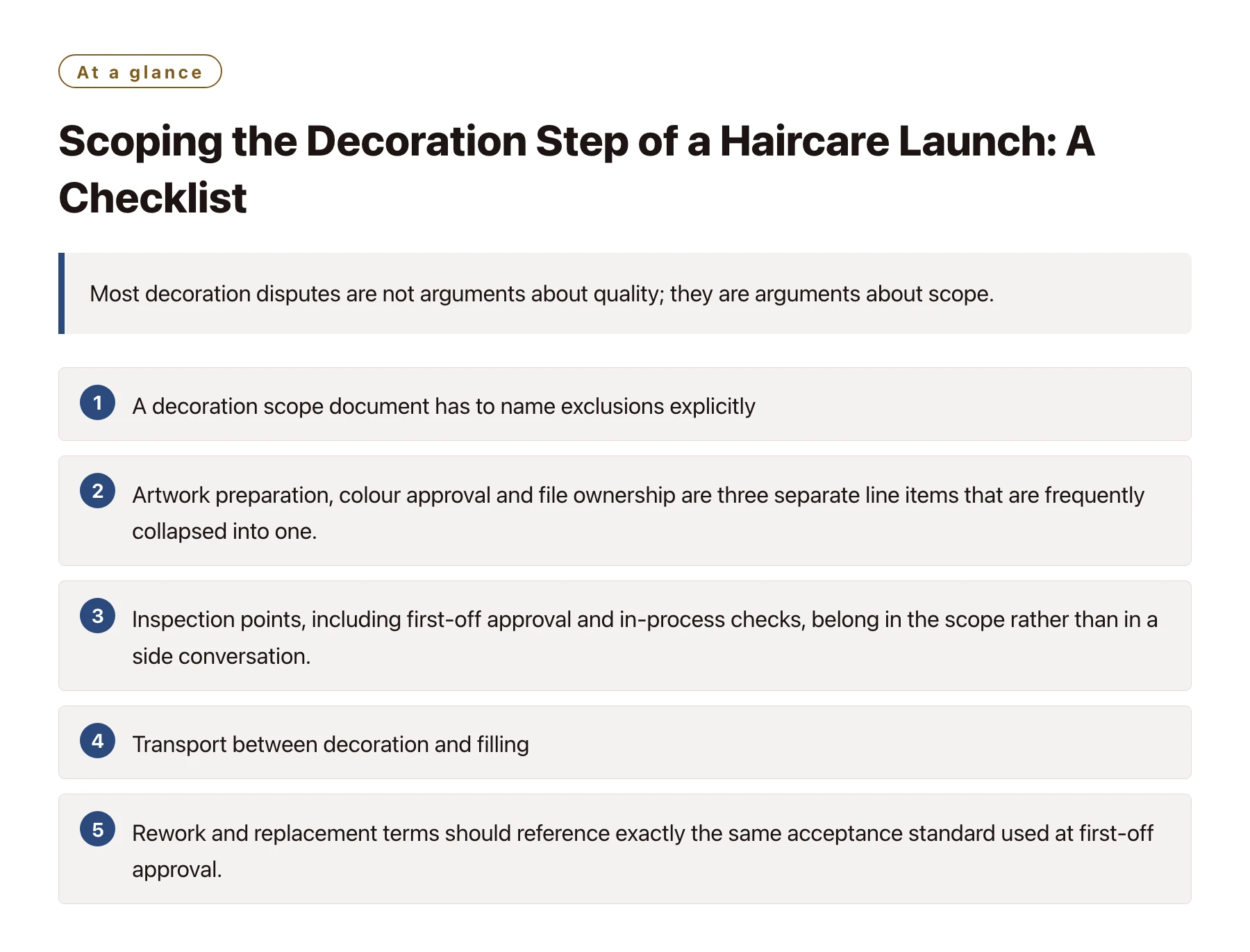
- A decoration scope document has to name exclusions explicitly, because an unlisted task defaults to whoever is standing closest to it.
- Artwork preparation, colour approval and file ownership are three separate line items that are frequently collapsed into one.
- Inspection points, including first-off approval and in-process checks, belong in the scope rather than in a side conversation.
- Transport between decoration and filling, and any storage in between, needs a named owner before the first pallet moves.
- Rework and replacement terms should reference exactly the same acceptance standard used at first-off approval.
A scope document is not a contract, and it is not a specification. It is a list of who does what, written in plain language, agreed before the work starts. Its value is that it converts assumptions into a document that can be checked in a meeting.
Decoration is unusually prone to scope confusion because the work sits between three parties: the brand, the decoration supplier and, quite often, the filler. Each of them can reasonably assume one of the others is handling artwork, inspection or transport.
This checklist is written for a haircare launch, where volumes are high, bottles are large and a single unassigned step can hold up a whole run.
In scope, out of scope, and who owns it
| Item | Usually inside a decoration scope | Usually excluded | Owner if it is needed |
|---|---|---|---|
| Artwork adaptation to the bottle | Adjusting the file to the print area, curvature and bleed | Original design work and brand-level creative | Brand's designer or an agreed third party |
| Colour approval | Producing a proof on the real substrate for sign-off | Approving a colour that was never proofed on the substrate | Brand, using the physical proof |
| Tooling | Manufacturing the plates, screens, cylinders or die | Ownership transfer and long-term storage | Whoever paid for the tooling, per the agreement |
| Decoration run | Printing, curing, inspection against the standard and packing | Filling, capping and labelling | The filler, under a separate scope |
| First-off approval | Producing first-off units and holding the run for sign-off | Deciding what the standard is | Brand, in writing and within an agreed window |
| Transport and storage | Packing decorated units so they survive transit | Freight to the filler and any warehousing between steps | Named party per leg, agreed in advance |
| Rework of rejected units | Removing and re-decorating where the substrate allows it | Cost of the bottle itself | Allocated by cause, defined at signature |
The third column is the one that prevents disputes. If a task is genuinely excluded, write it down as excluded rather than leaving the row blank.
The three questions a scope checklist has to answer
First, what is the deliverable? For decoration, the deliverable is not simply decorated bottles. It is decorated bottles that meet a stated standard, packed in a stated way, delivered to a stated place, with a stated record. Each of those clauses is a place where a project can stop.
Second, what does the brand have to provide, and by when? Most decoration delays trace back to an input the brand owes: the final artwork, the colour decision, the bottle specification or the approval. Naming the input and the date turns an open-ended wait into a scheduled task.
Third, what happens when something is not to standard? Rework, replacement, scrap and re-scheduling all need an owner. The industry association Cosmetics Europe publishes guidance and positions on behalf of the European cosmetics and personal care sector [1], which can be useful background when a brand is trying to describe a reasonable division of responsibility to a supplier.
Where the visual standard is hard to put into words, an agreed test method is a practical substitute. Independent laboratories list packaging and print performance testing among their cosmetics and personal care services [2], which gives both parties a shared vocabulary for what passing means.
How to build the checklist for your own project
- List the physical objects, not the departmentsArtwork file, tooling, decorated stock, approved first-off units, retained sample. Objects are easier to assign than responsibilities, and they cannot be left vaguely shared.
- Name one owner per objectA single named party for each line. Joint ownership in a scope document usually means nobody owns it.
- Write the exclusions in the same documentKeep inclusions and exclusions side by side so the boundary is visible when the document is read quickly.
- Attach the acceptance standardReference the signed proof, the master sample or the written criteria. A scope without a standard cannot be completed, only declared complete.
- Agree what happens at the end of the relationshipTooling, artwork files and retained records all need a destination. Deciding this at the start costs nothing.
Where scope creep shows up first
The first place is colour. A brand asks for a small adjustment after the proof, and the adjustment turns out to need a new plate or a new ink mix. If the scope says colour changes after proof are re-quoted, the conversation is short.
The second place is fill and assembly. A decorator that packs decorated bottles is not necessarily responsible for inspecting them after filling, yet brands often assume the supplier who touched the bottle last is the one to ask. Putting the inspection point in the scope removes that assumption.
The third place is volume. A scope agreed for one run does not automatically cover a repeat, a second scent in the same bottle or a larger quantity. Setting out how a re-order is scoped, priced and scheduled is part of the same exercise, and it is why the checklist pairs naturally with a partner such as a contract manufacturer for perfume brands that expects to run the same bottle shape more than once.
None of this requires legal language. A one-page table agreed by both sides, referenced in the contract and kept with the order, does more for a launch than a long specification that nobody reads. It also sits well alongside a private label partner for perfume lines whose scope is written down and can be compared line by line.
The test of a scope document is simple: hand it to somebody who was not in the meeting and ask them to say who inspects the decorated bottles and who pays for a rejected unit. If they have to guess, the document is not finished. Xuelei fragrance brand is one example of a supplier whose published scope can be checked against your own list.
Sources
- Cosmetics Europe —— The European trade association for the cosmetics and personal care industry, publishing guidance, positions and market information.
- SGS: Cosmetics, Personal Care & Household Testing —— Testing, inspection and certification services for cosmetics and personal care, including microbiological, stability and safety testing aligned with cosmetics GMP.
Frequently asked questions
Is a scope document the same as a specification?
No. The specification describes what the product is; the scope describes who does what. Both are needed, and confusing them is how responsibilities end up unclear.
Who normally pays for print tooling?
Usually the party that will use the tooling again, which is often the brand on a dedicated design and the decorator on a standard one. What matters is that the agreement states who owns the tooling and what it costs to move or remake.
Should the decorator inspect filled bottles?
Not by default. Decoration and filling are separate processes, and the party that fills usually inspects the filled unit. If you want the decorator to verify the decorated stock after filling, that has to be written into the scope as an additional step.
How do we handle a colour change after the proof is approved?
Treat it as a new decision with a cost and a date attached. State in the scope that colour changes after proof are re-quoted, and that the schedule restarts from the new approval date.
Does a scope document need to cover re-orders?
It helps. State how a repeat order is priced, how long a held line slot lasts and whether the standard from the original run still applies. Re-orders are where a good first run most often goes wrong.